Guides
Can You Have Multiple PayPal Accounts? (2026 Guide for Multi‑Account Users)
Can You Have Multiple PayPal Accounts? (2026 Guide for Multi‑Account Users)Guides
Managing finances across multiple brands, stores, or projects often leads to one question: can you have more than one PayPal account? The short answer is yes—but with strict limits. This guide breaks down PayPal’s official policies, the risks of pushing beyond them, and how to safely manage multiple accounts using the right tools and techniques.
Quick Answer: How Many PayPal Accounts Can You Legally Have?
PayPal officially permits one personal account and one business account per individual. Each account requires its own unique email address since this serves as the primary identifier in PayPal’s system.
Opening multiple accounts of the same type under the same identity—such as two personal accounts with your name—violates PayPal’s User Agreement. This isn’t a gray area; it’s explicitly prohibited and can result in account limitations, balance freezes for up to 180 days, or permanent bans.
Here’s what’s allowed:
| Account Type | Limit Per Person | Requirements |
| Personal Account | 1 | Unique email, phone, linked bank |
| Business Account | 1 | Unique email, business details, separate banking |
| Additional Business Accounts | Case-by-case | May be possible for legitimate separate businesses or enterprise structures, subject to PayPal approval, regional requirements, and separate verification |
Additional business accounts may be possible for legitimate separate businesses or enterprise structures. Requirements vary by region and should be confirmed with PayPal directly before opening additional accounts.
Some users run more accounts stealthily for arbitrage or multi-store setups, but this approach carries significant risk of detection and permanent bans. In this article, we’ll cover the rules, risks, proper setup procedures, and how Undetectable.io helps keep browser fingerprints and ip addresses isolated across different accounts.
Why People Use Multiple PayPal Accounts in 2026
Despite PayPal’s strict policies, multi-accounting remains common among e-commerce sellers, affiliate marketers, freelancers, and traffic arbitrage teams. The reasons are practical rather than malicious.
Common use cases include:
- Separating personal transactions from business income for cleaner tax reporting
- Running a dedicated paypal account for each online store or brand on platforms like Shopify, Etsy, or Amazon
- Freelancers isolating client payment flows (one account per major client reduces audit complexity)
- Arbitrage teams diversifying risk across several accounts—avoiding the single point of failure where one flagged account halts all operations
The benefits are practical. A diversified, compliant account structure can reduce the impact of a single account review, because one limitation does not necessarily stop every brand or project at once. When managing multiple paypal accounts correctly, you gain clearer analytics per brand, easier bookkeeping, and reduced downtime if a single account gets limited.
For online sellers handling different currencies or marketplaces, it is important to check PayPal’s regional rules, currency conversion fees, and business account requirements. Separate regional accounts may require legitimate local business presence, local banking, and compliant verification.
This approach connects directly to Undetectable.io’s core audience: digital marketers, media buyers, and arbitrage teams who already manage dozens of browser profiles across platforms like Facebook, TikTok, and multiple Google accounts.
PayPal’s Official Rules on Multiple Accounts
PayPal’s rules are codified in their User Agreement and apply globally, though regional variations exist. Here are the core policy points as of 2026:
What PayPal allows:
- One personal account and one business account per person
- Each account must have its own email and phone number
- Same card or bank account generally cannot be reused across multiple unrelated accounts
- Country-specific restrictions may apply (some regions require extra KYC, others limit business features)
The reasoning behind these rules:
PayPal enforces these limits for anti-fraud and anti-money-laundering (AML) compliance. Their systems analyze shared personal data, financial instruments, and digital signals to detect policy violations.
Opening “stealth” accounts with fabricated identities or forged documents violates not only PayPal’s terms but also financial regulations in jurisdictions like the US (under FinCEN oversight) and the EU (PSD2 directives).
PayPal reserves the right to:
- Freeze balances for up to 180 days
- Request enhanced verification checks (ID, proof of address, business documentation)
- Permanently limit accounts if linked violations are detected
Before changing your setup, check the current PayPal User Agreement and regional terms. PayPal regularly updates its User Agreement, fee pages, and regional requirements, so users should review the latest rules before changing their account setup.
Types of PayPal Accounts and What You’re Allowed to Do
Understanding account types is essential before opening more than one account. PayPal’s structure simplified around 2020 when legacy “Premier” accounts were merged into the current binary system.
Personal Accounts
Designed for individuals handling:
- Shopping online and making purchases
- Sending money and receiving money from friends/family
- Occasional or casual selling, depending on regional PayPal rules
Personal accounts do not provide the same merchant, team-management, and business reporting features available to Business accounts. Fees vary by country, payment type, and funding source. PayPal lists different rates for checkout payments, invoicing, card payments, goods and services transactions, and personal transfers.
Business Accounts
Built for merchants, companies, and registered sole proprietors:
- Full invoicing templates and recurring billing
- Multi-user access and role management, depending on the account type and region
- Deep integrations with e commerce platforms (Shopify, WooCommerce, eBay)
- Analytics on sales velocity and chargeback ratios
Business accounts can be opened by individuals doing business under a trading name or business name.
Allowed Combinations
| Scenario | Permitted? |
| 1 Personal + 1 Business (same person) | Yes |
| 2 Personal accounts (same person) | No |
| Multiple business accounts (same person) | Only if each belongs to a separate legal entity |
Serious sellers and arbitrage teams typically use business accounts for each project, as this provides clearer financial separation and improved reporting capabilities.
How to Set Up a Second (or Third) PayPal Account Correctly
This section provides a high-level roadmap for creating multiple paypal accounts compliantly—not a hack to circumvent paypal’s rules.
Preparation Steps
Before registering a new paypal account, gather:
- A unique email address (not just a Gmail +alias, which PayPal may pattern-match)
- A separate phone number (physical SIM preferred over VoIP for verification)
- Accurate personal and/or business address information that matches the documents PayPal requests for that specific account and jurisdiction
- Dedicated bank accounts or cards (no reuse where PayPal prohibits it)
- For additional business accounts: separate registration documents and tax information for each legal entity
Step-by-Step Registration Flow
- Log out of all existing PayPal sessions
- Clear browser data or use a fresh browser profile
- Visit paypal.com and click “Sign Up”
- Select account type (typically Business for a second account)
- Enter accurate personal or business information
- Link a dedicated bank account or card specific to that account
Verification Process
- Confirm email and phone number via PayPal’s verification flows
- Complete any KYC requests (ID upload, proof of address) within the deadline
- Keep submitted business information consistent across all documents
For additional business accounts beyond the first, repeat this process with completely separate legal entity data—different company name, registration, and banking for each.
Users planning several accounts should anticipate heightened scrutiny. New business accounts may be asked to complete identity, business, or address verification, especially when activity, volume, geography, or risk signals require additional checks.
Digital Signals PayPal Uses to Link Multiple Accounts
Accounts can be linked not only by name or bank information but also through technical signals that many users overlook.
PayPal monitors:
| Signal Type | What It Tracks |
| IP Addresses | Reputation, datacenter vs residential, GEO, ISP |
| Cookies/Local Storage | Previous session identifiers |
| Browser Fingerprinting | User-agent, screen resolution, fonts, WebGL, canvas, timezone |
| Device Patterns | Login times, frequency, simultaneous access |
Logging into multiple accounts from one unprotected browser at the same IP address can create obvious linkage patterns. PayPal and other payment platforms likely use automated risk models that can connect accounts through shared identity data, payment instruments, devices, IP patterns, cookies, and behavioral signals.
Critical points:
- Private or incognito mode does not reset fingerprinting—it only clears cookies
- Simultaneous logins from the same device or network can increase the chance that accounts are linked or reviewed
- Logging many accounts from the same home IP can create obvious linkage patterns and significantly increase review or limitation risk
Serious multi-account operators need strict isolation of browser profiles, hardware fingerprints, and unique ip addresses per account.
Managing Multiple PayPal Accounts Safely: Best Practices
Here’s a risk-reduction checklist for users who legally manage personal and business accounts or multiple business accounts under distinct entities.
One Clear Purpose Per Account
- Personal account for personal use only
- Main business account for primary operations
- Additional accounts for separate brands, stores, or GEOs
Strict Separation Requirements
- Emails and phone numbers: no reuse across accounts
- Payment methods: unique cards/bank accounts where required
- Addresses and legal entities: distinct documentation for each
Good Operational Habits
- Never access multiple accounts simultaneously from the same device or same ip
- Maintain consistent GEO behavior per account (no constant country-hopping)
- Keep organized records: passwords, 2FA methods, login credentials, and owner notes
Compliance Essentials
- Don’t use extra accounts to bypass chargebacks, bans, or limits
- Respond to PayPal’s documentation requests as quickly as possible and within the deadline stated in the request
- Close unused accounts rather than letting them sit idle with outdated data
Technical isolation with anti-detect tools isn’t a license to break PayPal rules—it’s about stability, privacy, and controlled workflows.
Technical Isolation for Legitimate PayPal Account Management
Technical isolation is useful when you manage a personal account and a business account, or multiple business accounts under legitimate entities. It helps prevent accidental session mixing, cookie contamination, and team workflow mistakes.
It does not allow users to bypass PayPal rules, register accounts with false data, evade chargebacks, or avoid account limitations.
Identity and Data Consistency
- Accurate verified identity or business information for each legitimate account
- Clear separation between personal and business account data
- Secure storage of account credentials, 2FA methods, business documents, and owner notes
Access Environment Consistency
- Residential proxies or mobile proxies tied consistently to one account per IP
- Avoiding multiple account logins from one proxy endpoint
- Matching GEO and timezone of proxy to the account’s declared location
Device and Browser Isolation
- One dedicated browser profile per PayPal account
- No sharing of cookies, cache, browsing history, or fingerprint settings
- Long-term “aged” environments rather than constantly rotating devices
User reports vary widely, and no isolation setup can guarantee that PayPal will not review, limit, or close an account. Technical separation can reduce operational mistakes, but it does not replace accurate account data, compliant business activity, and proper documentation.
Using an Anti-Detect Browser to Manage Many PayPal Accounts on One Device
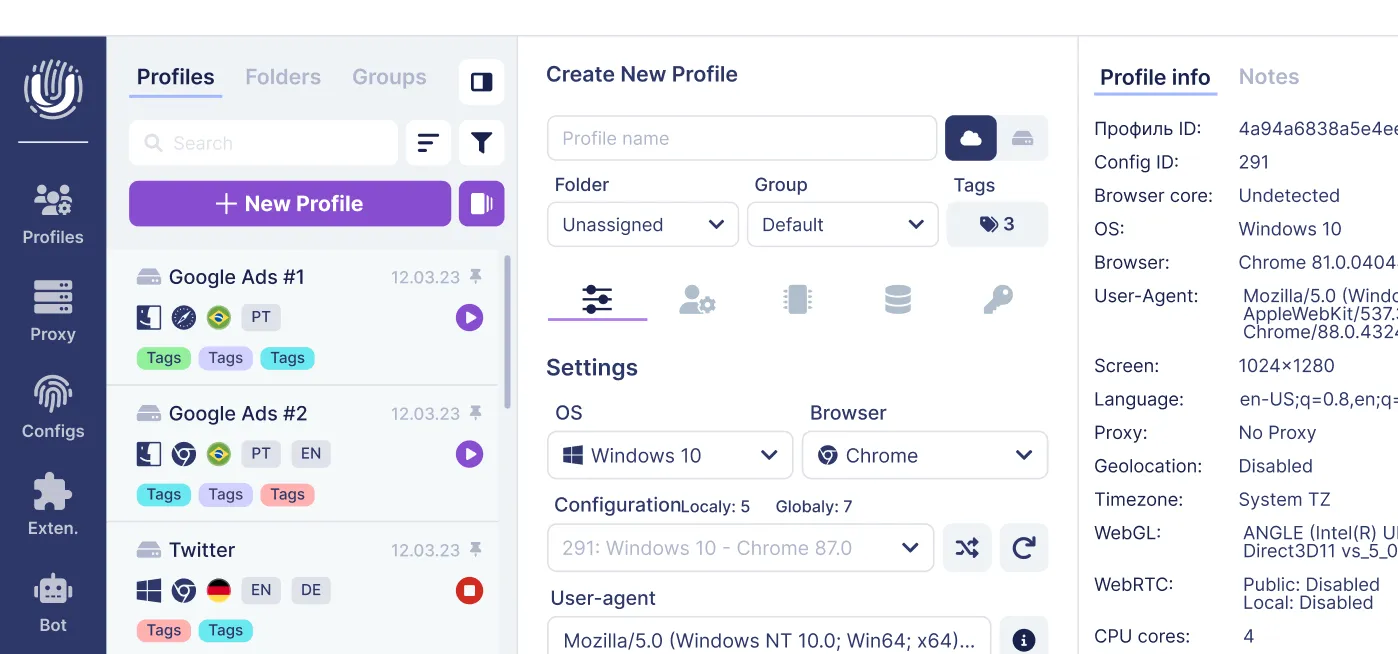
An anti-detect or multi-profile browser allows you to run isolated browser environments on a single device. Each profile maintains separate browser-level fingerprint settings, cookies, local storage, and session data, helping it behave like a distinct browsing environment.
Core Concept
- Each browser profile generates distinct fingerprint parameters
- Profiles don’t share cookies, local storage, or sessions
- You attach a different proxy to each profile for IP isolation
Benefits for PayPal Account Management
- One profile = one PayPal account, consistent over time
- Eliminates accidental cross-logins or cookie contamination
- Enables multiple team members to manage different accounts with lower risk of accidental cross-login or session mixing
Many professionals already use anti-detect browsers for Facebook Ads, TikTok, Amazon seller accounts, and Google properties. Extending this workflow to PayPal keeps your entire ecosystem consistent.
Key Features to Look For
- Realistic, customizable browser fingerprinting
- Local or cloud profile storage options
- Per-profile proxy management with third party proxies support
- Automation capabilities (Selenium, Puppeteer, Playwright)
How Undetectable.io Helps You Run Multiple PayPal Accounts
Undetectable.io is an anti-detect browser built specifically for multi-account workflows across advertising platforms, marketplaces, and payment systems like PayPal.
Key Features for PayPal Users
| Feature | Benefit |
| Unlimited local profiles | One profile per PayPal account—no extra seat costs |
| Isolated fingerprints | Screen, fonts, WebGL, audio, timezone, language per profile |
| Proxy integration | Assign dedicated third-party residential or mobile proxies to each profile through proxy management tools |
| Local storage | Profiles stay on your device, not on external servers |
Why Local Profiles Matter
With local profile storage, browser profile data is stored on your device rather than synced to Undetectable.io’s cloud. This can reduce exposure compared with cloud-synced workflows where profile data is stored on external servers.
Automation and Scaling
- API support (Selenium, Puppeteer, Playwright) for session warming and workflow automation
- Cookies robot for building natural browsing history before registering a new paypal account
- Profile warm-up capabilities that reduce detection risk for fresh accounts
Typical Workflow
- Create a new Undetectable.io profile with a realistic fingerprint for your target GEO
- Attach a unique residential proxy with its own unique ip address
- Log in or register the corresponding PayPal account only in that profile
- Reuse the same profile for all future sessions to maintain device identity stability
Users often report fewer workflow errors when each account is tied to a consistent browser profile and access setup, but no setup can guarantee uninterrupted PayPal access.
Ready to test multi-account PayPal management? Start for free on Windows or macOS with Undetectable.io’s free tier, and review Undetectable.io pricing plans to choose the right setup for your workflow.
Frequently Asked Questions About Multiple PayPal Accounts
Can I have multiple PayPal accounts in different countries?
PayPal requires a real local bank account, phone number, and address for each country. Cross-country multi-account setups trigger extra risk checks and international transactions scrutiny. Some users establish separate legal entities per region, but this is complex and must comply with local financial laws; others apply similar strategies when creating varias cuentas de Google de forma segura for different markets.
Can I link the same card or bank account to more than one PayPal?
Reusing the same bank account or card across unrelated accounts may create account-linking and verification issues, and PayPal may restrict or reject it depending on the account type and region. Legitimate separate accounts should use financial details that match the verified owner or business.
Can I use the same phone number or email for multiple PayPal accounts?
Each account must have its own email address and typically its own phone number. Using separate physical SIMs works best; reputable virtual number services may work but carry higher risk.
How many PayPal accounts am I really allowed?
The official limit is one paypal account (Personal) plus one business account per individual. You can have multiple business accounts only if each belongs to a separate legal entity with its own registration and banking.
Is using an anti-detect browser like Undetectable.io against PayPal rules?
PayPal’s rules focus on accurate identity, lawful activity, and compliance. Technical isolation tools should not be used to hide false data, evade chargebacks, bypass restrictions, or violate PayPal policies. Anti-detect tools can help separate browser environments, but PayPal may still review accounts based on risk signals.
Can I have two PayPal accounts for separate personal and business purposes?
Yes—this is exactly what PayPal permits. You can maintain one personal account and one business account under your name, as long as each has unique login credentials and linked financial information.
Conclusion: Multi‑Account Strategy and Risk Management
PayPal officially allows one personal and one business account per individual. Anything beyond that increases complexity, scrutiny, and risk of account suspension.
Core principles for 2026:
- Respect paypal’s rules and local financial regulations
- Keep each account’s identity, bank information, and technical environment completely separate
- Use separate browser profiles and consistent access environments to avoid accidental session mixing when managing legitimate accounts
Undetectable.io serves as a central tool for managing many isolated browser profiles, protecting privacy via local storage, and scaling arbitrage or e-commerce operations without chaotic login habits.
If you run multiple brands, stores, or arbitrage funnels, try Undetectable.io’s free plan on Windows or macOS. Build a safer, more controlled PayPal multi-account strategy—starting today.
Related posts
View all articlesJoin 450,000+ users who chose Undetectable
- Advanced anti-detection technology
- Unlimited local profiles from $49
- The perfect solution for multi-accounting