Guides
CoinList Multi Account: Risks, Detection & Safe Workflow with Undetectable.io
CoinList Multi Account: Risks, Detection & Safe Workflow with Undetectable.ioGuides
Managing multiple coinlist accounts has been one of the most debated strategies in the crypto industry since the first high-profile token sales launched on the coinlist platform. This guide breaks down the rules, the detection systems, the real risks, and how antidetect browsers fit into the picture for legitimate workflows.
Quick Answer: Is CoinList Multi-Accounting Worth It in 2026?
Multi-accounting on CoinList is explicitly prohibited by their Terms of Service and backed by strict rules around anti money laundering laws and identity verification. Token sales are monitored with strict identity verification to prevent manipulation, and using multiple accounts can lead to bans on CoinList. CoinList recommends managing all trading from a single verified account, and using bots or anti-detect tools is against CoinList's terms and may result in account termination. This article exists for educational and risk-awareness purposes only.
CoinList currently focuses on token sales and other onchain offerings, with assets delivered to non-custodial wallets controlled by users. CoinList Pro, centralized trading, and staking belong to the legacy platform; staking and related onchain earning offers were wound down by November 30, 2025. During the 2020–2022 token-sale boom, some users attempted to increase their allocation chances by operating duplicate accounts. CoinList publicly confirms that it analyzes devices, browsers, IP addresses, email legitimacy, bot-like activity, and unusual behavior to identify fraudulent accounts.
Undetectable.io does not encourage breaking CoinList rules. Traders comparing different setups often look at browseralternatives for multi-accounting before deciding how to manage workflows on less restrictive platforms. Key risks of multi-accounting include:
- Permanent account suspension or closure
- Blocked transactions, frozen funds, or delayed access during a compliance review
- Revocation of allocations or exclusion from future offerings where permitted by the applicable terms
- Possible legal exposure if fake documents, stolen identities, sanctions evasion, money laundering, or other fraudulent conduct is involved
What Is a CoinList Multi Account Setup?
A CoinList multi account setup means intentionally creating and using several separate accounts on the coinlist platform to participate in token sales, token distributions, or crypto trading from multiple identities or devices. Multiple accounts can be considered a violation to gain unfair advantages under CoinList's policies.
There are two distinct scenarios:
- One user trying to bypass queue and allocation rules with duplicate KYC profiles.
- An authorized organization or representative accessing accounts for separate real users, subject to each user's consent, CoinList's Terms, the applicable offering rules, and any additional onboarding or written agreements required by CoinList.
Multi-accounting is typically attempted around:
- Token sale queues and allocation mechanisms, where some users attempt to create numerous duplicate profiles to increase their chances
- Airdrops and reward programs tied to coinlist wallet activity
- Early access before new tokens move to major exchanges, since more accounts increase chances of obtaining limited tokens
- Staking programs and different services offered through the platform
The term "coinlist multi account" became popular in crypto forums and Telegram groups around big sales like Filecoin (2017), Flow (2020), and Archway/Neon (2023), when tens of thousands of users competed for limited allocations in each tokenized asset offering.
Why Traders Tried CoinList Multi-Accounting for Token Sales
CoinList was established in 2017 and is based in San Francisco, initially as a spin-off from Amalgamated Token Services Inc (later renamed). The platform quickly became the go-to launchpad for crypto projects because CoinList offers early access to new crypto tokens through structured sales with limited supply, registration windows, random queue positions, and per-account caps backed by strict KYC.
Here is the historical context that fueled multi-account strategies:
- 2017–2021:: CoinList hosted major token sales for projects such as Solana, Casper, and Flow. Some of these tokens later delivered exceptionally high returns relative to their sale prices, increasing demand for subsequent launches. During this period, CoinList also operated centralized trading products that are now part of its deprecated legacy platform.
- 2022–2023: Market cooling, but strong demand persisted around token projects like Archway and Neon Labs with valuations reaching hundreds of millions of us dollars.
One account meant one chance in the sale queue, which tempted users to create many "slots" to increase their odds. Some users also spread capital across accounts to participate in multiple sale options-different tranches, lockups, or purchase tiers-simultaneously. While the perceived added benefit was a bigger token allocation and more chances at 10x–100x returns on each asset class, this came with massive compliance and ban risk that many underestimated.
CoinList Rules: What Their Terms Say About Multiple Accounts
CoinList is operated by Amalgamated Token Services Inc. and its subsidiaries. Its current Terms describe CoinList as a technology platform that provides infrastructure, compliance screening, eligibility workflows, onboarding, and distribution support for token sales and other onchain products. CoinList states that it is not a bank, broker-dealer, exchange, custodian, money services business, or payment processor. Their Terms of Service lay out clear restrictions that affect anyone considering more than one account.
Key obligations and restrictions include:
- CoinList may require identity verification before a user can access specific services or participate in a token sale. For individual users, the current verification process may include a full name, residence details, date of birth, selfie and liveness check, government-issued ID, and occupation. Additional information may be required depending on the user's jurisdiction and the applicable offering.
- Registration includes KYC and AML compliance checks. Each account must complete separate kyc verification using authentic identities-KYC compliance requires distinct verifications for each individual account.
- Depending on the service, jurisdiction, and offering, users may be asked to provide their name, residential address, date of birth, government-issued ID, selfie and liveness check, occupation, proof of address, tax information, phone number, or source-of-funds documents.
- CoinList determines whether to refuse, suspend, or terminate any coinlist account at their sole discretion for fraud, prohibited use, or policy violations. CoinList may suspend, restrict, or close accounts that it considers to be circumventing its controls, including accounts opened to bypass allocation, eligibility, or promotional limits. CoinList states that the criteria behind such decisions may remain confidential.
- CoinList prohibits transferring account access or account rights to a third party, including through the purchase of a CoinList account, except where the transfer occurs by operation of law.
- Failing to comply with CoinList's terms can lead to severe consequences on trades and access, including permanent bans and frozen digital assets.
Token sales, token distributions, and on-chain capital markets products are legally sensitive. CoinList must comply with U.S. Bank Secrecy Act, anti money laundering requirements, OFAC sanctions, and applicable laws in other jurisdictions. Creating duplicate accounts may violate CoinList's Terms. Using fake documents, stolen or rented identities, or other deceptive information may also create serious legal risks and may result in information being disclosed where required by law, legal process, or a governmental request. Their Sybil prevention blog post from 2024 describes active efforts to detect clusters of fraudulent accounts.
How CoinList Detects Multi Accounts: Fingerprints, IPs & Patterns
Modern crypto platforms like CoinList use layered detection to identify multiple accounts. Before experimenting with any setup, privacy-focused users often check their fingerprint uniqueness on tools like AmIUnique.org together with an anti-detect browser. Here are the primary vectors, explained in accessible terms:
- Device fingerprints: OS version, screen resolution, installed fonts, WebGL renderer, canvas hash, and audio context create a unique digital fingerprint for each computer or device. CoinList's terms explicitly flag "accessing multiple accounts from the same device" as abusive activity.
- Browser metadata: user agent strings, timezone, language settings, and hardware concurrency all contribute to identifying whether sessions originate from the same environment.
- Network indicators: using shared IP addresses can trigger detection of multiple accounts. Datacenter IPs, known VPN endpoints, and ASN clustering are red flags. Tools like BrowserLeaks.com for anonymity checks can reveal what IP, DNS, and WebRTC data a platform might see. CoinList operates in many countries but restricts some regions, so geo-mismatch between your IP and KYC country raises risk scores.
- Behavioral analytics: CoinList states that it screens for bot-like and unusual activity. It does not publicly disclose the exact behavioral variables or thresholds used in its risk models. Separate activity patterns do not make duplicate or unauthorized accounts compliant.
Individual users may be required to submit a selfie, complete a liveness check, and provide a government-issued ID. Verification time varies depending on the jurisdiction, offering, submitted documents, and whether additional review is required. CoinList does not publish a universal verification timeframe of 7 to 10 business days.
Since 2023, CoinList has strengthened automated risk scoring. Simple tricks like incognito windows, cheap VPNs, or clearing cookies are no longer sufficient. The platform uses persistent fingerprinting that links profiles beyond IP alone, incorporating device-level and behavioral signals to protect users and platform integrity.
Typical Multi-Account Mistakes That Get CoinList Users Banned
Here are the most common operational errors that lead to detection and bans. Understanding these patterns is essential even for those legitimately managing different clients' accounts or exploring multi-account strategies on communities like Reddit where similar risks apply.
Common device and network mistakes:
- Logging into 3–4 accounts from the same normal browser profile on one computer
- Reusing the same mobile device, Wi-Fi network, and IP address across multiple KYC profiles
- Sharing one coinlist wallet withdrawal address or same external wallets deposit address for all accounts
- Using cheap public VPN or datacenter proxies that hundreds of other users share
Specific failure patterns:
- Passing KYC on one account and then immediately trying to verify a second account with nearly identical data (similar selfies, overlapping ID numbers)
- Creating numerous accounts within a short period during a token sale may appear suspicious, but CoinList does not disclose any fixed numerical threshold that automatically triggers enforcement
- Funneling tokens from several accounts into one address on external wallets right after a sale ends
Once a cluster is flagged, CoinList may:
- Suspend, restrict, or close linked accounts
- Block transactions or freeze funds while taking action under its Terms
- Require additional verification or a compliance review
Creating multiple accounts results in risks like account suspension and loss of funds. Maintaining unique identities and distinct environments is necessary for each account. Understanding these patterns helps anyone who manages accounts for other users-such as family members or clients-avoid accidental linkage that could trigger security measures on legitimate activity.
Undetectable.io Basics: Anti-Detect Browser for Multi-Account Workflows
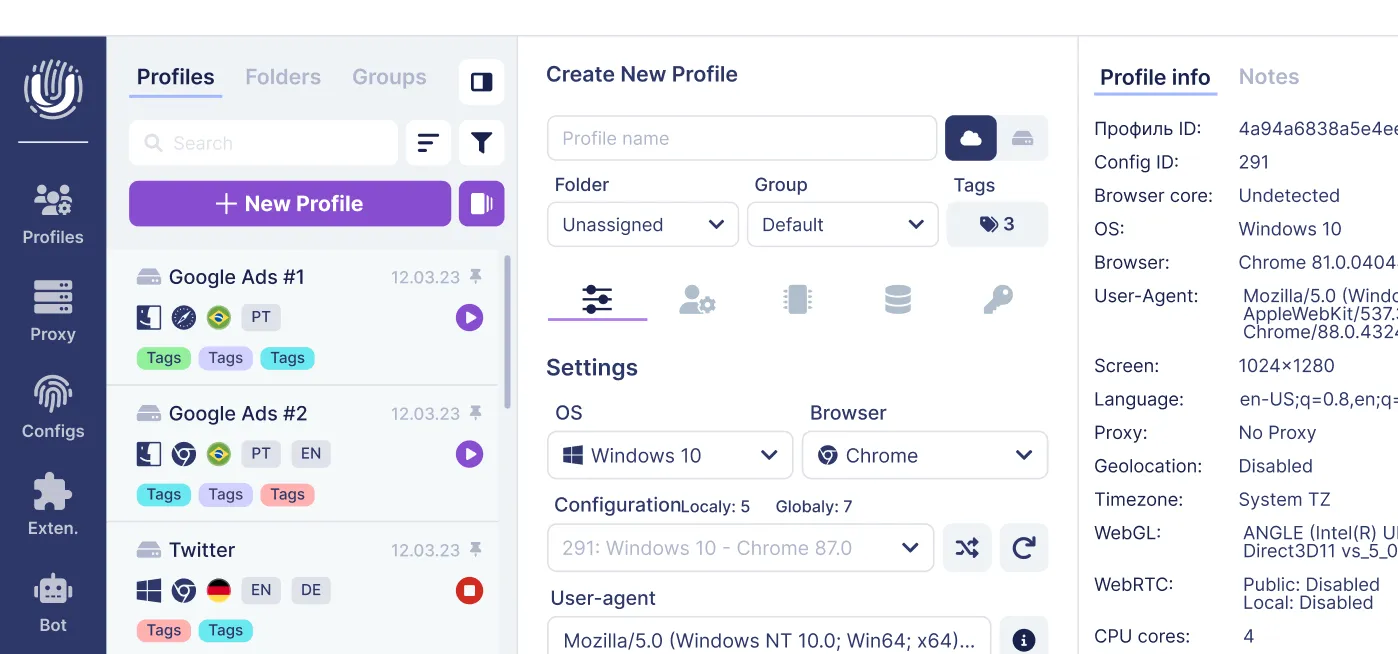
Undetectable.io is an antidetect browser built for professionals who run many accounts across platforms-ad networks, social media, marketplaces, and airdrop campaigns. It is not designed specifically to bypass CoinList rules, but rather to provide session isolation and fingerprint management for legitimate multi-account workflows.
Core capabilities include:
- Creation of hundreds or thousands of unique browser profiles with separate fingerprints, using real device configurations rather than randomized parameters
- Local profile storage by default, so sensitive data stays on your machine rather than on external servers
- Integrated proxy management per profile, supporting mobile and residential proxies; users can compare the best proxy services to choose stable, high-trust IPs
- Cookie robot to warm up profiles and make them look like normal browsing histories
- API and automation tools for teams and SaaS workflows
While tools like Dolphin{anty} also allow managing multiple accounts from one device, Undetectable.io differentiates with unlimited local profiles on any paid plan and full local data control. Mobile proxies are recommended for better account trustworthiness on sensitive platforms.
For agencies or crypto funds that lawfully manage multiple verified users (each with their own coinlist account), Undetectable.io helps:
- Isolate sessions technically and avoid cross-contamination of cookies and fingerprints
- Distribute connections across multiple ISPs, countries, or mobile networks via proxies
Using Undetectable.io to impersonate other people, falsify KYC, or violate exchange terms is against ethical use and may be illegal under applicable laws.
Authorized Account Access: Compliance Considerations for Teams and Representatives
This section is for agencies and teams that legitimately serve multiple clients, each with their own coinlist account, and want to reduce accidental linking. CoinList may require KYC verification before a user can access specific services or participate in an offering. Verification may include a selfie, liveness check, and government-issued ID, but processing time varies. Technical session isolation does not replace authorization from CoinList or compliance with its Terms.
Recommended structure:
- Each client = one dedicated Undetectable.io profile with its own fingerprint
- Each profile is tied to a separate quality proxy: ideally mobile or residential IP from the same country as the client's documents and residential address
- No simultaneous logins to multiple coinlist accounts from the same profile
Device and network hygiene:
- Avoid logging into client coinlist accounts from casual personal browsers or mobile apps
- Keep a logbook of which proxy and profile is assigned to which client to avoid mixing sessions
- Never let clients share login details across profiles
Practical examples:
- A small crypto fund in 2026 managing 20 verified investors' coinlist accounts for token sales and staking via power of attorney, where each investor has completed their own registration and KYC
- A marketing agency that only handles UX walkthroughs and support, while clients create account credentials and complete their own KYC steps on dedicated profiles
All identity documents, selfies, and legal responsibilities must stay with the real owner of the coinlist account. The agency's role is operational management, not identity creation.
Proxies and Fingerprints for CoinList: What Actually Matters
Proxy choice is critical for any platform with strong security measures like CoinList. Visit coinlist from the wrong IP type and you risk immediate flagging.
Key proxy principles (and choosing robust options such as PlainProxies for professional use):
- Mobile and residential proxies look much closer to real user connections and are less likely to be rate-limited
- Datacenter and mass-market VPN IPs are frequently flagged because they appear on shared blocklists
Concrete guidance:
- Use one static or slowly rotating high-quality proxy per coinlist user, not one shared proxy for dozens of accounts
- Match proxy geolocation (country and region) with the user's KYC data and indicated address to avoid geo-mismatch risk scores
- Avoid frequent, unnatural IP changes (rotation every 30 seconds during login or participation in a token sale looks more suspicious than a stable connection)
Undetectable.io lets users:
- Attach a specific proxy to each browser profile via the built-in proxy manager
- Fine-tune browser fingerprint parameters (timezone, language, fonts, GPU) to align with the proxy location and client device story
Consistency matters more than complexity. A profile that always connects from the same residential IP in the same country as its KYC documents, with stable fingerprint parameters, will look far more legitimate than one that jumps between data centers every session.
Compliance, Privacy & Risk Management for CoinList Users
CoinList is a regulated platform with strong AML and sanctions obligations. Users must provide accurate identity data, accept KYC checks, and understand that anonymity on CoinList has strict limits imposed by anti money laundering laws and U.S. regulations.
What Undetectable.io does and doesn't protect:
- It protects against tracking via browser fingerprinting across the wider web and helps separate different workspaces and client sessions
- It does not hide identity from KYC providers once real documents and selfies are submitted
- It cannot bypass face id, biometric checks, or document verification on the coinlist platform
Users should:
- Read CoinList's Privacy Policy and U.S./EEA/CCPA notices to understand how their data is stored and processed
- Avoid any use of fake identities, synthetic IDs, or purchased KYC data-these carry serious legal consequences beyond just a platform ban
CoinList offers two factor authentication for account protection and, according to their claims, has never been hacked. The platform provides a free wallet for storing various cryptocurrencies, and users can earn rewards by staking assets on CoinList. When you are ready to transfer funds, click the withdraw button inside your account.
CoinList does not publish one universal fee schedule for all current services. Fees may vary depending on the offering, jurisdiction, user type, integration, wallet provider, and blockchain network. The 0.5% transaction fee, CoinList Pro trading fees, fixed BTC withdrawal fee, and wire-transfer fees relate to the legacy centralized platform and should not be presented as CoinList's current universal fee structure.
Operational safeguards for teams:
- Maintain internal documentation and contracts when managing third-party accounts
- Use hardware security keys and strong 2FA even inside Undetectable.io profiles to protect CoinList login credentials
- Follow the link provided by CoinList for any device approval or new login confirmation emails promptly
Conclusion: Using Undetectable.io Responsibly with CoinList
CoinList multi-accounting became popular because of high ROI token sales and random queue mechanics, but it now carries high ban and legal risk. CoinList's current services focus on token sales and other onchain offerings, with assets delivered to non-custodial wallets controlled by users. Legacy centralized trading and staking products have been phased out. CoinList may restrict or close accounts used to circumvent its controls, including accounts opened to bypass allocation, eligibility, or promotional limits. Companies and individuals alike face the same enforcement standards.
Undetectable.io is designed for privacy, automation, and legitimate multi-account management on platforms that permit it. For CoinList, it should be used only to safely organize and isolate sessions for real, compliant users-teams and agencies managing verified clients-not to create fake identities or violate terms. Every project on CoinList carries participation rules, and every country has its own applicable laws around crypto assets and digital assets.
If you manage many web accounts and care about anonymity and anti-detection, you can start with Undetectable.io's free plan or review Undetectable.io pricing plans in detail, then test profile creation, proxy management, and the cookie robot on less sensitive platforms first. Always consult local law and platform terms before applying any multi-account strategy to regulated crypto services like CoinList.
Related posts
View all articlesJoin 450,000+ users who chose Undetectable
- Advanced anti-detection technology
- Unlimited local profiles from $49
- The perfect solution for multi-accounting