Reviews
Cloaking: How It Works, Why It Matters, and How Undetectable.io Fits In
Cloaking: How It Works, Why It Matters, and How Undetectable.io Fits InReviews
Introduction: What "Cloaking" Really Means Today
The word "cloaking" conjures images of sci-fi invisibility and cloaking devices that render starships invisible to sensors. In the digital world, the concept is surprisingly similar-but instead of bending light, cloaking bends information. At its core, cloaking means deliberately showing different content or behavior to different users: one version for search engines, another for human visitors; one landing page for ad reviewers, another for real traffic.
This article will examine cloaking across its major modern contexts: black-hat SEO tactics that deceive Google and Bing, ad cloaking in Facebook and TikTok ecosystems, traffic filtering used in affiliate arbitrage, and network cloaking that hides critical infrastructure from the outside world. We'll look at how cloaking works in real time, how platforms detect it, the legal and ethical risks involved, and where privacy tools like Undetectable.io fit in.
Undetectable.io builds antidetect browser technology for anonymity and multi-account management-not for running scams or tricking ad reviewers. That distinction matters, and this article will make it clear.
From Capes to Code: The Origins and Evolution of Cloaking
Invisibility has fascinated humans for centuries-from enchanted cloaks in folklore to radar-absorbing stealth aircraft in the 20th century. In the physical sciences, the pursuit continues: metamaterials can guide light around objects, enabling invisibility at certain wavelengths.In 2014, researchers demonstrated optical cloaking in a laboratory-created water-based diffusive medium, showing that cloaking principles can work even in strongly scattering environments. Active camouflage allows objects to blend into surroundings using adaptive panels, while the Rochester Cloak uses lenses to achieve visible light cloaking. Plasma-based stealth has also been explored as a theoretical and experimental method for reducing radar visibility by absorbing, refracting, or scattering electromagnetic waves.
In the digital world, cloaking emerged in the late 1990s when website operators began showing keyword-stuffed pages to crawlers and clean pages to visitors. Search engines penalized the practice, but it evolved. During the late 2010s and early 2020s, commercial cloaking services became increasingly available to black-hat advertisers seeking to evade review systems on major advertising platforms. Meanwhile, network cloaking gained traction in operational technology, where hiding devices from reconnaissance tools became a legitimate security method rather than a deceptive tactic.
Types of Cloaking in the Digital World
The term "cloaking" is overloaded-it means different things depending on the discipline. Here's how the major types compare:
SEO cloaking involves showing one page to Googlebot and a completely different one to human visitors. Cloaking is a black-hat SEO technique that shows different content to search engines and users. For instance, doorway pages present gateway content to crawlers to rank for dozens of keywords, while users see something unrelated. Cloaking includes practices like hiding prohibited content from search engines while showing it to users-think pharmaceutical offers or restricted marketplace products.
Ad cloaking presents safe "white pages" to ad reviewers, bots, and security scanners during campaign review, then swaps in aggressive "offer pages" for real users. This can happen both before and after the click.
Traffic cloaking / traffic filtering separates visitors into categories-profitable humans vs. bots, moderators, and spy services-then routes each group to different destinations.
Network cloaking makes devices in OT/IoT environments invisible to unauthorized scans. Unlike the other types, this is primarily defensive: devices don't respond at all without cryptographic authentication.
Undetectable.io operates in the browser fingerprint and multi-account space. Its technology can be used ethically for ad testing, GEO-based A/B tests, and competitive research-without deceptive cloaking against platforms.
How Cloaking Works Technically: Core Mechanics and Real-Time Decisions
Modern cloaking works in real time, making per-request decisions based on dozens of parameters. Here's the basic flow:
- A visitor hits a cloaked URL or ad
- The cloaking system collects environmental signals
- A rules engine or ML model classifies the visitor as "real user" or "bot/reviewer"
- The system routes to an offer page or a white page accordingly
The signals analyzed include:
- Network: IP address/ASN, VPN/proxy/datacenter vs. residential origin, country
- Device: OS, browser type and version, screen size, hardware concurrency
- Behavioral: referrer, cookies, language, time zone, JavaScript capabilities
- Fingerprinting: Canvas/WebGL rendering hashes, font enumeration, audio context, battery API, media devices, touch vs. mouse support
User-Agent inspection is used in cloaking to serve different content to bots and humans-it's one of the oldest and simplest checks. IP delivery is a method of cloaking by serving different content based on user IP addresses, routing datacenter IPs to safe pages and residential IPs to monetization flows.
Simple rule-based systems rely on static whitelists and blacklists. More advanced setups use ML models trained on historical data to determine whether a request is from a reviewer or a genuine visitor. These adaptive systems continuously learn, making them harder to defeat.
Cloaking operates both on the server side-using HTTP redirects, response code manipulation, and content switching-and on the client side, where obfuscated JavaScript rewrites the DOM, conditionally loads iframes, or triggers redirects based on browser fingerprint checks. Cloaking techniques exploit gaps in traditional security systems by operating in the space between what crawlers see and what the browser actually renders.
Research from the Cloak of Visibility study found that among ad URLs tied to high-risk keywords, roughly 4.9% to 11.7% displayed cloaking behavior depending on the keyword category.
Ad Cloaking: White Pages, Offer Pages, and Malvertising Campaigns
Ad cloaking is one of the most damaging applications of the technique. Malicious actors use it to slip harmful campaigns through ad reviews on networks like Google Display Network, Facebook, TikTok, and native ad platforms. Ad cloaking hides malicious URLs from detection tools, making it possible to drive traffic to dangerous destinations while appearing clean to reviewers.
The "white page" is a safe, brand-suitable landing page shown to scanners, bots, or suspected moderators. These pages are often AI-generated, multi-language, and niche-relevant-designed to pass brand safety checks without raising flags.
The "offer page" is the real destination. It might be a fake antivirus prompt, an investment scam, an aggressive sweepstakes, or a site pushing forced push-notification malware. Cloaked ads can lead users to malware or phishing sites, and the malicious nature of these pages is only visible to the targeted audience.
Pre-click cloaking serves different ads based on user parameters-swapping ad creatives or tags depending on whether the viewer is a moderator or a real user. Post-click cloaking is harder to detect than pre-click cloaking because the ad creative itself looks clean; only the redirect behavior after the click varies by device, GEO, or referrer. For example, Google reviewers might see a benign online store, while EU Android users are redirected to a fraudulent subscription trap.
Real-time bidding and programmatic ads make this scalable. In programmatic advertising, cloaking may be introduced by malicious advertisers, affiliates, compromised websites, tracking systems, or other actors that manipulate the content or redirects delivered to different visitors. A joint investigation reported by TechRadar identified more than 15,500 malicious domains that abused the Keitaro advertising tracker as part of cloaked campaigns, including AI-themed investment scams.
Cloaking in SEO: Why Search Engines Treat It as Black-Hat
Search engines like Google prohibit cloaking in their spam policies because it fundamentally undermines the integrity of search results. Classic SEO cloaking patterns include:
- Showing keyword-stuffed text to bots while display of a polished page to human visitors
- Using doorway pages or auto-generated content visible only to crawlers
- Presenting compliant product information to search engines and aggressive, prohibited offers to real visitors
Consider a pharmaceutical affiliate site: it serves medically compliant product information to Googlebot, earning high rankings, while visitors clicking those results see aggressive prescription-drug offers that violate both platform rules and potentially the law.
Cloaking deceives search engines to achieve higher rankings for irrelevant terms and creates an unfair advantage for dishonest sites over compliant competitors. Search engines aim to rank pages that match a user's search intent without cloaking-so when they identify it, the response is severe. Cloaking can lead to severe penalties including de-indexing from search results, manual actions requiring formal reconsideration requests, and ranking drops that can take months to recover from.
Websites utilizing cloaking can compromise user trust and experience, and cloaking can expose websites to legal actions for consumer deception. It's important to note that acceptable variations in content delivery do not mislead search engines or users-for instance, serving different language versions based on Accept-Language headers or adapting layouts for mobile devices is legitimate personalization, not cloaking.
Network Cloaking and OT Security: Making Devices Invisible
Network cloaking is a defensive concept used in operational technology environments-power grids, manufacturing plants, water treatment facilities, and data centers. Unlike SEO or ad cloaking, network cloaking is about protection, not deception.
Network cloaking makes OT systems invisible to hackers by ensuring that devices simply don't respond to unauthorized probes. Network cloaking drops all unauthenticated traffic silently-no ping replies, no port scan responses, no service banners. From the perspective of a conventional unauthenticated port scanner, protected services may appear unreachable or absent, substantially reducing their exposure to reconnaissance.
This approach protects legacy devices that cannot be patched, which is common in industrial control systems running outdated firmware. Network cloaking prevents attackers from exploiting vulnerabilities by eliminating the reconnaissance phase entirely. It also counters AI-powered attacks by hiding the network, since automated scanning and exploitation tools can't target what they can't find. The result: it reduces the attack surface for operational technology systems dramatically.
The Cloud Security Alliance has published guidance on Network-Infrastructure Hiding Protocols (NHP), combining Software-Defined Perimeter concepts with single-packet authorization to enforce invisibility of resources until explicit cryptographic authentication occurs.
For Undetectable.io readers: while our tools operate at the browser and proxy level, understanding network-layer cloaking helps security teams design layered defenses. The trade-offs are real-powerful attack surface reduction comes with operational overhead, strong authentication requirements, and the need to avoid locking out legitimate maintenance access.
Ethical vs Abusive Cloaking: Where the Line Is Drawn
Not every form of differentiated content delivery is abusive. The line sits at intent to deceive platforms, search engines, or users.
Legitimate variations include:
- GEO-based pricing and currency display
- Language negotiation via browser headers
- A/B testing with transparent analytics
- Privacy-driven anti-tracking measures and antitracker solutions
- Fraud defenses that verify IP or device signals
Abusive cloaking includes:
- Hiding scams, malware, or fake login pages from moderators
- Serving banned content only to vulnerable user groups
- Presenting malicious creatives to real visitors while showing clean versions to reviewers
Google, Facebook, and major ad networks all ban cloaking as a method of policy evasion. Regulators can treat it as part of fraud schemes, especially when consumers are harmed.
Undetectable.io's antidetect browser is designed for anonymity, multi-account management, and privacy for legitimate use cases-ad testing, team workflows, competitive research, and running multiple Facebook ad accounts safely. It does not endorse using cloaking to violate platform terms of service.
A helpful checklist: "Would the user, the platform, and a regulator all say they were fairly informed?" If any answer is "no," it's likely abusive cloaking.
How Cloaking Is Detected: Signals, Anomalies, and Real-Time Defenses
Modern detection has moved well beyond static blacklists. Platforms and anti-fraud systems now analyze behavioral, environmental, and temporal signals in real time.
Typical anomaly signals include:
- Unusual CTR spikes followed by high bounce rates
- Sudden CPM or quality score drops
- GEO or device mismatches between review and live traffic
- Inconsistent content snapshots between crawler views and user views
- Spam reports from users who see content that doesn't match ad creatives
Security vendors run continuous, distributed scans from varied IP ranges, devices, and time zones to simulate real visitors and trigger cloaked behavior. They create environments that mimic mobile Safari in specific countries using residential IPs, then monitor for redirects, script swaps, and content changes.
Machine-learning approaches cluster landing pages, ad creatives, and redirect graphs to identify common cloaker infrastructure patterns. Behavioral profiling compares bot-like navigation paths against genuine human interaction-session duration, scroll depth, click patterns-to identify when a site is treating different users differently.
The arms race is constant. Bad actors add more sophisticated fingerprinting to distinguish "scanner" devices from real ones, while defenders randomize fingerprints and increase coverage. Tools like "Cloaker Catcher" have been developed to collect spider-views and user-views simultaneously, comparing them to expose differences in IP-based and SEM cloaking.
Risks of Cloaking for Marketers, Affiliates, and Businesses
While cloaking can produce short-term gains-fast ad approvals, inflated rankings, diverted revenue-the long-term risks are severe.
Platform consequences:
- Ad account bans on Google, Facebook, and TikTok, often with loss of remaining ad spend balances
- Domain blacklisting across ad networks
- Inability to create or operate new accounts at scale
SEO-specific risks:
- Removal from search indexes, sometimes permanently
- Multi-month traffic collapses that can cripple a site's revenue
- Expensive recovery projects involving content audits, rewriting, and resubmission
Legal and financial exposure:
- Association with malware, scams, or cloaking attacks can attract regulatory investigations
- Civil claims from affected users for damages caused by threats like phishing or forced subscriptions
- Payment processor shutdowns and affiliate program terminations
Indirect business impact:
-
Inability to connect with reputable networks or marketplace partners once labeled as cloakers
-
Reputational damage that affects email deliverability and brand credibility
The takeaway: using advanced tools like antidetect browsers, proxies, and automation ethically-for testing, compliance, and segmentation-avoids these risks while still delivering performance benefits.
Cloaking, Fingerprints, and Anti-Detection: How Undetectable.io Fits In
Undetectable.io is an antidetect browser built for anonymity and multi-account work-not a cloaking service. Understanding the distinction requires understanding browser fingerprinting.
Platforms and search engines use fingerprints to link accounts and identify repeat visitors. These signals include Canvas and WebGL rendering outputs, installed fonts, plugins, OS and hardware patterns, time zones, screen parameters, and more. A single computer can generate a highly unique fingerprint that platforms use to detect multi-accounting or suspicious behavior. Recent data shows browser-tampering events grew 69% year-over-year, reflecting how central fingerprinting has become to platform security.
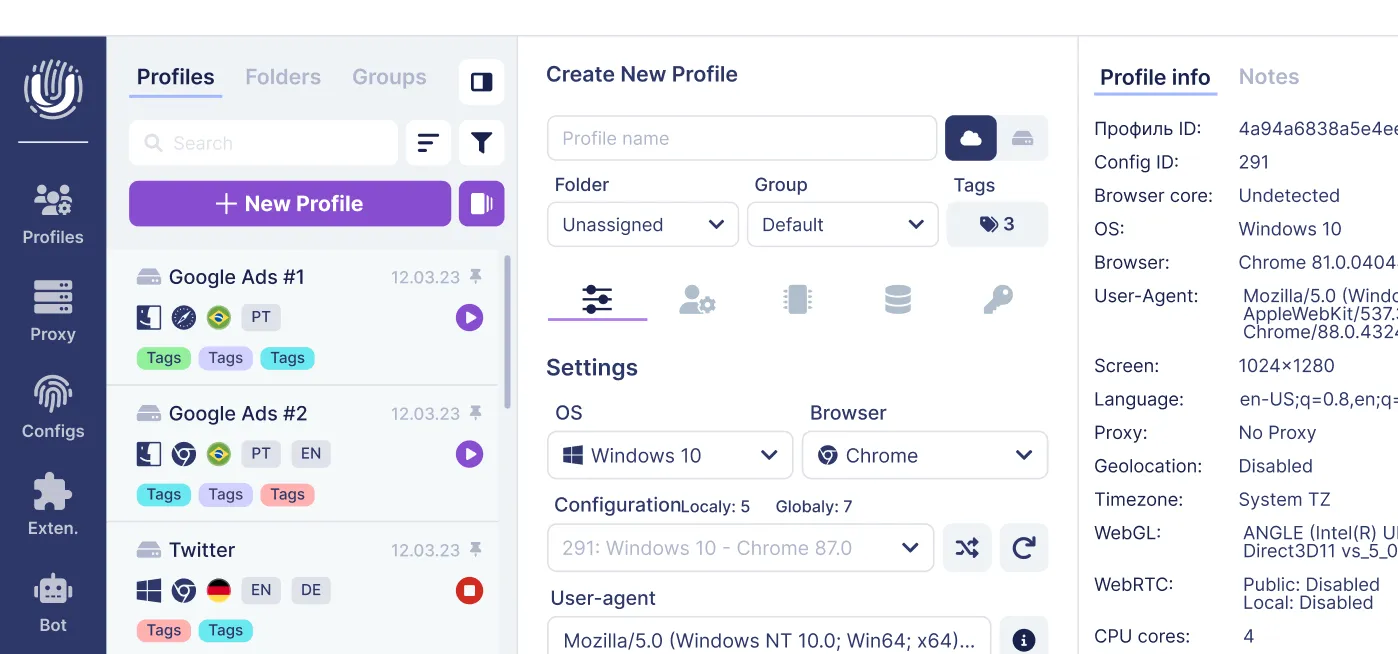
Undetectable.io lets you create many isolated browser profiles with unique, realistic fingerprints. Each profile has its own cookies, localStorage, proxy configuration, and environment settings. Unlike competitors that cap profiles or force cloud storage, Undetectable.io offers unlimited local profiles on any paid plan-your data stays on your device, giving you full control.
Legitimate scenarios include:
- Running separate ad accounts for different clients without cross-contamination
- Testing ad creatives across GEOs and devices to verify how they display
- Warming up new accounts with a cookies robot that visits relevant sites
- Conducting competitive research without leaking your browser fingerprint
- Managing multiple social media accounts safely
The same technological ideas-environment detection, fingerprint control-are present in both cloaking systems and antidetect tools. The ethical difference lies in purpose: privacy and account hygiene vs. tricking search engines or ad reviewers.
Ready to explore safe multi-accounting and anonymity? Start for free with Undetectable.io and see how profile isolation works without crossing into abusive cloaking territory.
Best Practices to Stay Safe Around Cloaking Technologies
Whether you're a marketer, publisher, or security professional, you may not control all cloaking in your ecosystem-but you can manage your exposure.
For advertisers and affiliates:
- Maintain strict internal policies forbidding deceptive cloaking against search engines and ad platforms
- Use transparent GEO and device targeting in campaign setup
- Audit landing pages regularly for consistency between what reviewers and users see
For publishers and networks:
- Integrate real-time scanning and behavioral analytics to catch cloaked ads
- Monitor CTR, bounce rate, and GEO anomalies for signs of cloaked traffic
- Use honeypot accounts to verify what ads actually serve to different visitors
For security teams:
- Layer network cloaking for critical OT with web application firewalls and bot management
- Conduct periodic manual reviews of high-risk traffic flows
- Test your own presence from external vantage points to verify nothing leaks
For Undetectable.io users:
-
Separate profiles by client, business unit, or project
-
Assign dedicated proxies per profile to avoid cross-linking
-
Warm profiles gradually with natural browsing behavior
-
Respect platform terms of service-use isolation for compliance, not misrepresentation
When anonymity, performance, and policy compliance are aligned, tools like Undetectable.io strengthen your operation rather than exposing it to cloaking-related risks.
Conclusion: The Future of Cloaking and Real-Time Defenses
Cloaking is an ongoing cat-and-mouse game. As cloaking works in more advanced ways and in real time, defensive systems and platform policies evolve in parallel. The arms race shows no signs of slowing down.
The critical distinction remains: defensive cloaking-network invisibility for vulnerable infrastructure, privacy tools for legitimate users-serves a fundamentally different purpose than abusive cloaking used in malvertising, black-hat SEO, and policy evasion. One protects; the other deceives.
Emerging trends point toward wider use of AI for both cloaking and detection, more granular fingerprinting of devices, and stricter enforcement from ad platforms and regulators. The limitations of traditional defenses will push the industry toward zero-trust models and real-time behavioral analysis.
Undetectable.io's position is clear: empowering users with strong, ethical anonymity and multi-account capabilities, while discouraging practices that rely on deceiving platforms or end users. The technology is powerful-what matters is how you use it.
Explore Undetectable.io's antidetect browser to build resilient, compliant operations that remain effective even as cloaking and anti-cloaking technologies continue to evolve.
Related posts
View all articlesJoin 450,000+ users who chose Undetectable
- Advanced anti-detection technology
- Unlimited local profiles from $49
- The perfect solution for multi-accounting