Reviews
SMS Verify: Secure SMS Verification Codes for Multi-Account Work
SMS Verify: Secure SMS Verification Codes for Multi-Account WorkReviews
Managing dozens of accounts across platforms means facing SMS verification on a daily basis. Here is everything you need to know about how it works, where it falls short, and how to use it effectively alongside an anti-detect browser.
What is SMS verification (and why it still matters in 2026)?
SMS verification sends a one-time code to users' phones via text message to confirm a user's identity during sign-up, login, password reset, or other high-risk actions. Common terms you will encounter include sms verification code, verification code, OTP (one-time password), and SMS-based 2FA or MFA - all describing the same core process.
Here is a concrete example: a user logs into a marketplace on 27 July 2026 and receives a 6-digit sms verification code. SMS verification codes are typically six digits long, and the user enters it within 60–120 seconds to complete login. SMS verification is widely used for account logins and financial transactions, commonly used in banking and social media, and is familiar to most users, ensuring ease of use.
The key trade-off is convenience versus security. SMS verification works on any mobile phone and does not require apps, making it highly accessible since it requires only a mobile phone. It can reach 97% of the world's population. However, it is not as strong as hardware keys or FIDO2/WebAuthn passkeys. For Undetectable.io users - marketers, arbitrageurs, SMMs - sms verification appears constantly when creating accounts on Google, Facebook, TikTok, Amazon, and many others. This article covers how to safely use it with temporary phone numbers and anti-detect browsers for multi-account workflows.
How SMS verification works step by step
This section walks through the full lifecycle of an sms verification code from request to validation.
Sign-up flow: A user submits email, password, and phone number (e.g., +1 415 555 0199 in E.164 format). The service then sends an sms verification code to confirm ownership of that phone number. The system generates a short-lived verification code sent via text message.
Code format: One-Time Passwords are typically 4 to 6 digits and expire within minutes. Codes are single-use only. SMS verification services can deliver codes in under 10 seconds, with most sms verification codes typically delivered within seconds.
Login flow: After the password is accepted, the backend generates an OTP, stores a hashed version with an expiry timestamp, and sends it via an SMS gateway. The user enters the code, and the backend compares the input against the stored hash. SMS verification involves user input and code generation through a system working together.
UX details and fraud checks: Many platforms support OTP autofill. On iOS, the operating system detects eligible codes and offers them through AutoFill, while Android apps can use dedicated APIs such as the SMS Retriever API when properly implemented. Before sending, the service checks the phone number formatting (E.164), applies rate limits, and runs fraud checks on velocity, IP, and device fingerprint. Advanced providers add SIM swap detection, number intelligence, and traffic monitoring before approving the verification attempt.
Security pros and cons of SMS verification
SMS verification enhances security beyond just a password, but it carries real weaknesses that matter for business operations and power users.
Pros:
- Easy for end users - no extra apps or hardware, works on feature phones.
- Ubiquitous global reach - works wherever mobile coverage exists. SMS verification reaches 97% of the world's population.
- Low friction for onboarding; good for quickly securing new accounts. Implementing SMS verification is inexpensive compared to other methods.
- SMS verification increases user trust in a platform's security.
- SMS verification is effective against unauthorized access and reduces account takeovers. It can block almost 100% of automated bot attacks and reduce phishing attempts, helping prevent automated bot activity and fraud.
- SMS verification can prevent fake account creation and fraud, and can prevent account takeover risks.
Cons:
- Vulnerable to SIM swapping and number-porting fraud, where an attacker convinces a carrier to move the victim's phone number to a new SIM. Risks of SMS verification include SIM swaps and interception attacks via SS7 protocol flaws.
- Risk of interception via SS7 attacks and malware on rooted or jailbroken devices.
- Lost or stolen device issues - if the screen is unlocked, verification codes can be read directly.
Major companies like Twitter, Google, and Microsoft have nudged customers toward app-based TOTP or security keys while keeping SMS as a fallback. SMS verification is more secure than relying solely on a password, but for high-value targets - ad accounts, finance dashboards, large balances - it should be combined with other controls. For highest security, use an authenticator app or hardware key in addition to SMS verification. Undetectable.io users running many accounts should treat SMS as one layer in a broader strategy.
Temporary phone numbers and SMS verification for multi-accounting
A temporary phone number is a virtual, short-lived number used to receive sms verification codes online without exposing your primary SIM. Temporary phone numbers help maintain user privacy during verification and can receive SMS messages instantly. Services like SMS-Activate, which offers virtual numbers for any registrations, add new temporary numbers daily, expanding the pool of available virtual numbers worldwide.
Key use cases for multi-account operators:
- Testing signup flows across countries.
- Warming up ad accounts and social media profiles.
- Separating work and personal identities.
- Scaling multi-account setups for affiliate or traffic arbitrage.
Public vs. private numbers: Free public numbers are shared - all sms verification codes are visible to anyone, creating higher risk of account takeover and bans. Private rental numbers are unique to you for a set period, offering better long-term account stability and compliance with platforms that block VoIP ranges. SMSPool offers non-VoIP numbers for reliable SMS verification.
Typical workflow: Select a country, choose the target service (Facebook, TikTok, Amazon, Yahoo, WhatsApp), get a temporary phone number, request an sms verification code, and read the incoming message on the provider's dashboard or via API.
**Platform risk:**Some sites flag known disposable numbers, heavily reused numbers, or suspicious verification patterns and may restrict or ban accounts associated with these signals. Serious multi-account users should pair reputable SMS verification services with proper browser fingerprint isolation and residential or mobile proxies, then periodically audit their setup with anonymity checks on BrowserLeaks.com.
Using Undetectable.io safely with SMS verification and phone numbers
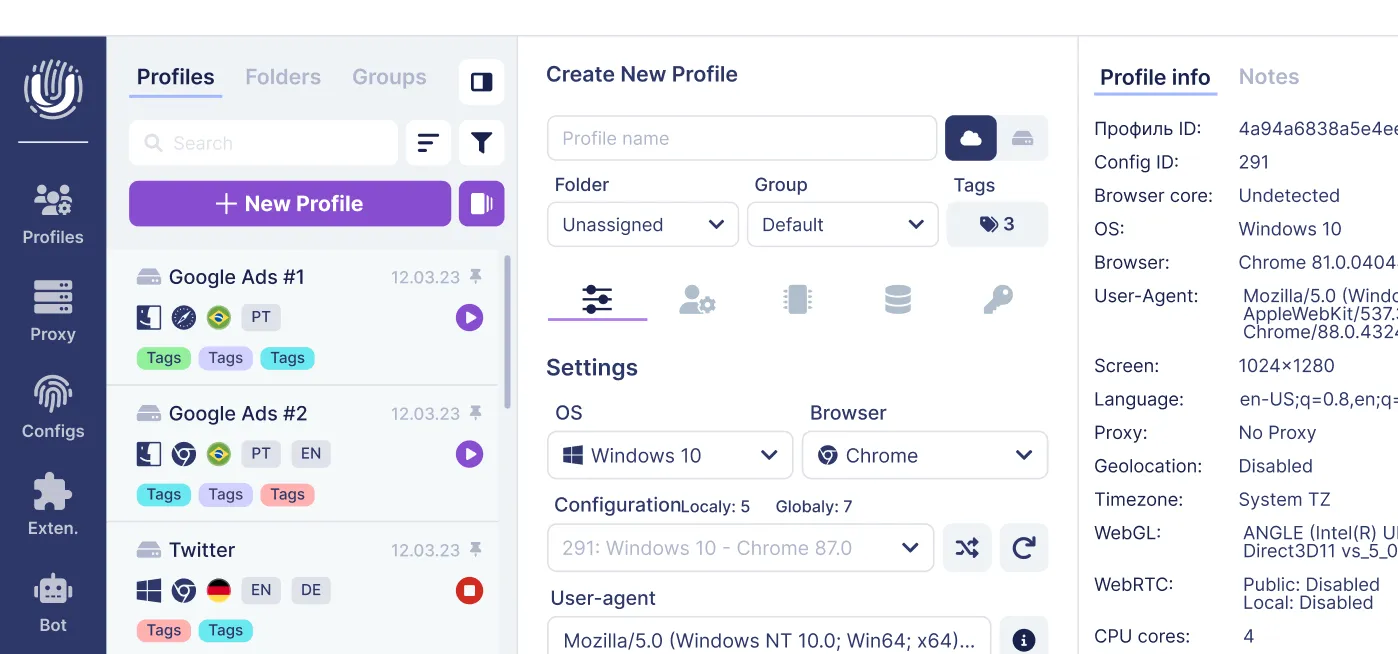
Undetectable.io is an anti-detect browser for Mac and Windows built to manage many unique browser profiles, which is essential when using phone numbers for sms verification across multiple accounts.
Sites read attributes like user agent, canvas, WebGL, fonts, timezone, and language, then combine them with IP address and phone number data to detect multi-account behavior. Undetectable.io counters this by letting you:
- Create hundreds or thousands of unique local profiles with distinct fingerprints.
- Assign different proxies (residential or mobile) per profile, matching the country of the phone number used for verification.
- Store cookies and sessions separately so each account keeps its own browsing history and trust score.
Concrete workflow: A media buyer creates 20 profiles for 20 Facebook accounts, uses 20 separate temporary or rented non-VoIP phone numbers, assigns each profile a matching GEO proxy, performs sms verification once per account, then gradually warms them with human-like browsing and the cookies bot.
All local profiles remain on your device, reducing exposure of phone numbers, SMS content, and login cookies to third-party servers. For agencies, cloud profiles let teammates share access securely without forwarding text messages or codes manually.
Choosing an SMS verification service or temporary phone provider
The reliability of SMS delivery and phone number quality directly determines whether your verification succeeds and your account survives.
Delivery reliability:
- Look for high success rates (above 99% for mainstream platforms) and sub-10-second average delivery speed for verification codes.
- Support for major platforms: Google, Meta, TikTok, Telegram, WhatsApp, Amazon, Steam, and many others. Telesign's verification API reaches 97% of the world's population, illustrating the scale a strong provider should offer.
Number quality:
- Preference for real, non-VoIP mobile phone numbers when platforms block cheap VoIP ranges.
- Stable private numbers that are not heavily recycled - ideal for accounts you plan to keep long term.
Global coverage and GEO matching:
- Availability of phone numbers in key countries you target (US, UK, EU, SEA, LATAM, MENA).
- Ability to match phone number country, proxy location, and language or timezone in your Undetectable.io profile to reduce red flags.
Security and privacy:
- Clear data retention policy for messages and phone numbers.
- No public logs of received codes if you pay for private numbers.
- Optional cryptocurrency payments for additional privacy where allowed.
Integration and automation:
- Robust API, webhooks, and developer documentation.
- Compatibility with your own tools and Undetectable.io's automation via local APIs or RPA bots to streamline mass account creation at scale.
Best practices and alternatives to SMS verification
Here is a practical checklist to reduce risk when you must use sms verification, plus a quick look at alternative methods.
SMS best practices:
- Avoid reusing the same temporary phone number for many unrelated accounts on the same platform.
- Do not use free public numbers for critical assets like ad accounts with large budgets or payment platforms where you pay real money.
- Keep your primary SIM secure with a PIN lock, device encryption, and no screenshots of verification codes stored in cloud galleries. Protect your devices from compromise.
Operational hygiene for multi-accounting:
- Align IP (proxy), device fingerprint, timezone, and phone number GEO for each profile in Undetectable.io.
- Spread sign-ups over days to look organic instead of registering dozens of accounts in a single hour from related phone numbers.
- Regularly back up important profiles (cookies, sessions) so losing access to an SMS number does not immediately lock you out of a site or page you depend on.
Alternatives and complements:
- TOTP authenticator apps (Google Authenticator, 1Password, Aegis) for stronger MFA on key accounts.
- Email verification and recovery emails kept separate per identity.
- Push-based approvals and FIDO2/WebAuthn security keys for admin or finance-sensitive logins across multiple channels.
SMS verification will continue to exist as an accessible, low-cost baseline - a solution that works on a company of any size. But serious operators should combine it with stronger authentication methods, disciplined identity separation, and an anti-detect browser like Undetectable.io to stay secure and deliver complete results. Start for free and choose from Undetectable.io pricing plans to build profiles that match your phone number strategy from day one.
Related posts
View all articlesJoin 450,000+ users who chose Undetectable
- Advanced anti-detection technology
- Unlimited local profiles from $49
- The perfect solution for multi-accounting