Reviews
KYC Crypto: How Identity Verification Shapes Privacy, Compliance, and Multi‑Account Work
KYC Crypto: How Identity Verification Shapes Privacy, Compliance, and Multi‑Account WorkReviews
KYC in the Crypto Industry Today
If you use centralized cryptocurrency exchanges, you have almost certainly encountered crypto KYC - the identity verification gate that stands between you and full platform access. KYC stands for Know Your Customer, and it is generally required for centralized cryptocurrency exchanges and other regulated virtual asset service providers operating under AML laws in many major jurisdictions.
The crypto industry sits at a crosspoint. On one side, regulated crypto exchanges and financial institutions require kyc verification before letting users deposit fiat currency or unlock higher limits. On the other, privacy-focused crypto platforms and decentralized exchanges offer alternatives that skip traditional identity checks entirely.
Since the FTX collapse in late 2022, enforcement pressure has surged. The Financial Action Task Force has tightened its travel rule, the EU's MiCA regulation went fully live in December 2024, and U.S. and UK regulators have levied record fines. This article covers what KYC means in crypto, how the kyc process works, what happens when compliance fails, how no-KYC alternatives fit in, and how tools like Undetectable.io help professionals manage privacy and multi-account workflows without breaking the law.
What Does KYC Mean in Crypto? (Know Your Customer Basics)
At its core, kyc for crypto is the regulated process where crypto exchanges and other Virtual Asset Service Providers (VASPs) verify a customer's identity before granting full access to services. It mirrors the know your customer requirements that traditional financial systems have used for decades under anti money laundering and counter-terrorist financing frameworks like the Bank Secrecy Act in the U.S. and EU AML directives.
During a typical kyc process, users provide:
- Full legal name and date of birth
- Residential address (utility bill, bank statement)
- Government-issued ID (passport, driver's license, national ID card)
- A selfie or video confirmation - KYC may involve biometric verification such as a selfie or video confirmation
KYC processes include identity verification and ongoing monitoring, but they connect to broader compliance concepts:
| Concept | What It Covers |
| CDD (Customer Due Diligence) | Standard identity checks at onboarding |
| EDD (Enhanced Due Diligence) | Deeper checks for politically exposed persons or high-risk clients |
| KYT (Know Your Transaction) | On-chain and off-chain transaction monitoring |
| Ongoing Monitoring | Continuous screening of user activity and sanctions lists |
A practical example: you sign up for a centralized exchange account, provide an email, then upload your ID for basic KYC. Higher tiers unlock when you submit proof of address and source-of-funds documentation, granting larger withdrawal limits and access to margin trading.
Why Is KYC Important for Cryptocurrency Exchanges and Financial Institutions?
KYC is one of the foundational elements of an AML compliance program, alongside transaction monitoring, sanctions screening, risk assessment, recordkeeping, and suspicious activity reporting. Most cryptocurrency exchanges are treated as Money Service Businesses or VASPs, which means kyc compliance is not optional - it is a legal requirement. KYC is legally required for cryptocurrency exchanges under AML laws, and kyc procedures screen users against sanctions and criminal databases including OFAC, EU, and UN watchlists.
The regulatory rationale is straightforward: identity verification helps financial institutions and crypto exchanges assess customer risk, detect money laundering, prevent fraud, and block terrorist financing. KYC helps prevent money laundering and financial crimes by connecting digital wallet addresses to actual individuals, addressing the anonymity that otherwise makes crypto assets attractive to money launderers.
When kyc measures fail, the consequences are severe. Over $1 billion was lost to crypto fraud between 2021 and 2022. In response, Binance paid a historic $3.4 billion settlement in 2023 for willfully failing to perform KYC on many users. In January 2025, KuCoin agreed to pay penalties and forfeiture totaling nearly $300 million after pleading guilty to operating an unlicensed money transmitting business in the United States. Regulatory penalties can arise from non-compliance with KYC at any scale.
On the business side, strong kyc compliance preserves banking relationships, payment rails, and operating licenses. From the user perspective, KYC enhances customer trust in cryptocurrency exchanges, reduces scams and rug pulls, and KYC reduces market volatility by ensuring legal compliance across the crypto market. Strong KYC measures improve the security of cryptocurrency trading platforms. KYC helps prevent over $1 billion in crypto fraud annually through these combined controls.
How KYC Works on Crypto Platforms: Processes, Tiers, and Transaction Monitoring
Most centralized crypto platforms use a tiered kyc verification structure. KYC requirements vary by country and platform, but the general pattern looks like this:
| Tier | Access Level | Data Required |
| No/Low KYC | Crypto deposits, very small withdrawal limits | Email or phone only |
| Basic KYC | Fiat deposits, moderate limits | Government ID, personal details |
| Full KYC | All trading pairs, large withdrawals | Proof of address, source of funds |
| Enhanced | OTC, margin, institutional features | Detailed financial documentation |
KYC enables higher transaction limits and access to additional services at each tier. It also facilitates account recovery in case of lost credentials, since the platform can verify the customer's identity against stored records.
The technical identity verification process runs through several automated steps: document upload, AI-based OCR extraction, liveness and selfie checks, and database screening against sanctions lists. Custodial wallets must comply with KYC practices just like exchanges.
Beyond verifying who someone is, platforms deploy KYT (Know Your Transaction) tools - services like Chainalysis, Elliptic, and Crystal Blockchain - to flag suspicious crypto wallets and flows in real time. This ongoing monitoring feeds into risk scores that determine whether an account warrants further due diligence or a Suspicious Activity Report.
Crypto kyc providers and SaaS identity verification solutions integrate via API into exchanges, NFT marketplaces, and fiat on-ramps, automating these compliance requirements so platforms can scale the onboarding process without manual bottlenecks. The Travel Rule may require regulated VASPs to transmit specified originator and beneficiary information when processing qualifying virtual asset transfers, including domestic or cross-border transfers depending on the jurisdiction.
Benefits and Risks of Crypto KYC: Security vs. Privacy
The benefits of robust kyc processes are concrete:
- Reduced fraudulent activity and better fraud prevention across crypto platforms
- Account recovery options tied to verified user identities
- Higher withdrawal and trading limits
- Easier cooperation with law enforcement after hacks or theft
- Protection against illicit funds entering the crypto market
But the downsides are equally real. KYC processes can take days or weeks to complete, especially during peak demand. The onboarding process requires submitting sensitive information - government IDs, biometrics, personally identifiable information - creating centralized honeypots of data. KYC data breaches can expose users to identity theft risks, and breaches at identity verification vendors have leaked millions of document scans across the broader financial sector.
Here is the paradox: KYC is designed to protect users and prevent money laundering terrorist financing, but centralizing personal details creates exactly the kind of target that criminals exploit. 84% of US adults have experienced social engineering scams, and stolen identity data fuels these attacks.
Meanwhile, determined criminals can sometimes bypass weak KYC with stolen IDs, synthetic identities, or deepfakes. Honest crypto users bear the friction - slow verifications, document rejections, IP-based flags - while sophisticated actors still attempt to slip through. This tension between security and privacy drives many users toward alternatives.
No‑KYC and Low‑KYC Options: DEXs, P2P Markets, and Privacy‑First Services
The distinction starts with custody. Custodial crypto exchanges and custodial wallets must comply with KYC regulations because they hold your private keys and therefore your funds. Non-custodial wallets - hardware wallets, MetaMask, and similar tools - do not require KYC compliance because users control their own crypto wallets directly.
For trading without kyc, several alternatives exist:
- Decentralized exchanges (DEXs): Uniswap and Bisq are popular DEXs without KYC. Decentralized exchanges allow trading without identity verification by matching orders through smart contracts rather than centralized order books.
- P2P platforms: Services like Bisq and RoboSats facilitate peer-to-peer crypto transactions with no centralized intermediary requiring identity documents.
- Crypto ATMs: Crypto ATMs enable purchases without KYC requirements at low thresholds, though limits vary by jurisdiction and operator.
The trade-offs are significant. KYC-free exchanges may have higher risks of scams, wider spreads, lower liquidity, and more personal responsibility for security. Some no-KYC and non-custodial services offer limited customer support and cannot restore lost private keys. Recovery options and legal protections vary by the service model and jurisdiction.
Privacy-focused infrastructure like VPNs and Tor-based services can supplement these tools. However, legal gray areas persist: decentralized exchanges face increasing regulatory scrutiny for KYC, and the travel rule and local global regulations may indirectly affect even non-custodial services that interface with regulated platforms.
Crypto KYC, Multi‑Accounting, and Anti‑Detect Browsers (Undetectable.io Angle)
Multi-account work is deeply embedded in the crypto ecosystem. Professionals run airdrop farming campaigns, referral programs, arbitrage strategies across cryptocurrency exchanges, traffic monetization funnels, and cross-platform marketing operations. Each of these workflows often requires managing dozens or hundreds of accounts.
Crypto KYC rules create a hard constraint: each identity can typically pass verification only once per platform, and platforms cross-reference device fingerprints, IP addresses, and browser data to detect overlap. A single shared fingerprint can trigger account freezes across every linked profile.
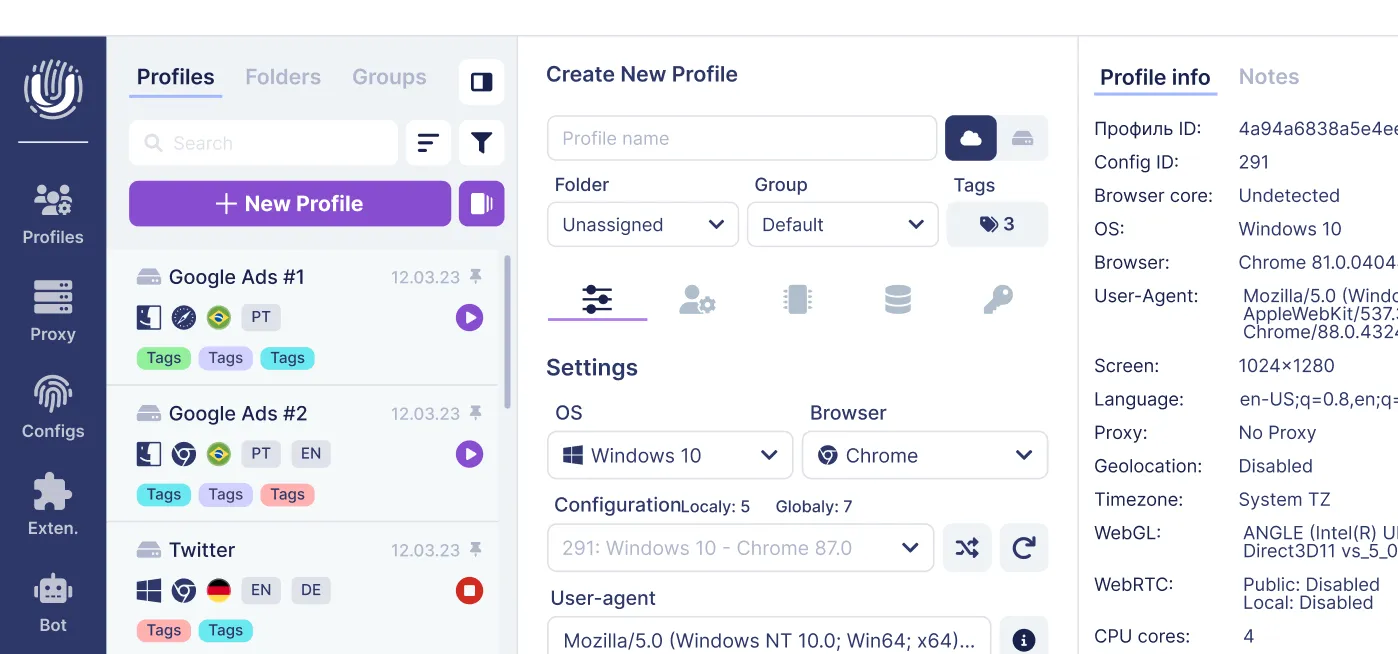
This is where Undetectable.io fits in. As an antidetect browser built for privacy and professional multi-account management, it lets digital marketers, arbitrage specialists, and social media managers run isolated browser profiles - each with unique fingerprints, separate proxy connections, and independent cookie histories.
The ethical and legal stance is clear: Undetectable.io is designed for privacy, security, and professional workflows - not for falsifying KYC documents, forging identities, or violating AML laws. The tool helps you compartmentalize, not impersonate.
Legitimate use cases include:
- Managing dozens of social media or ad accounts around one verified exchange account
- Segregating business and personal crypto activity for operational security
- Running airdrop distribution campaigns across multiple platforms
- Creating bulk profiles for marketplace or e-commerce operations
Key product features relevant to crypto professionals: unlimited local profiles on any paid plan, local storage of browser fingerprints (your data stays on your device), proxy management for clean geolocation consistency, and a cookie bot for warming profiles. These capabilities support compliant, compartmentalized work while helping you mitigate risk from cross-tracking and fingerprint correlation. You can audit your browser fingerprint to verify that each profile appears unique to platforms.
Future of KYC Crypto: Travel Rule, Zero‑Knowledge Proofs, and Self‑Sovereign Identity
KYC regulations are constantly evolving to combat illegal financial activities. The FATF updated its travel rule in June 2025, enforcing stricter information requirements for cross-border transfers. MiCA now fully applies across the EU, requiring all crypto-asset service providers to obtain authorization and implement kyc standards.
Privacy-preserving alternatives are gaining traction. Zero-knowledge proofs allow users to prove attributes - "I'm over 18," "I'm not on a sanctions list" - without exposing full identity data. Microsoft's "Vega" project demonstrated practical ZKP age verification from mobile IDs in under 100 milliseconds on commodity devices.
Self-sovereign identity (SSI) and decentralized identifiers (DIDs) offer an alternative to centralized KYC databases. Pilot projects in Europe and Asia—including Bhutan’s National Digital Identity system and initiatives based on decentralized identifiers and verifiable credentials—are exploring user-controlled digital identity models.
As crypto evolves, AI and machine learning accelerate both document checks and deepfake detection. KYC will likely expand into NFT marketplaces, metaverse platforms, and certain DeFi frontends, creating significant challenges for the crypto compliance landscape. Anti-detect browsers and privacy tools will remain essential for everyday anonymity and security as these changes unfold.
Practical Tips: Navigating Crypto KYC While Protecting Your Privacy
Before completing kyc on any exchange, follow this checklist:
- Prepare valid documents - ensure your ID is not expired and your proof of address is recent
- Verify the platform - confirm the URL, check for HTTPS, and enable two factor authentication before uploading anything
- Review the privacy policy - understand how long the crypto company retains your data and who they share it with
- Use strong unique passwords and a dedicated email address for financial transactions
To minimize data exposure:
- Share only what legal requirements demand - nothing more
- Never send identity documents over chat or email
- Periodically review which crypto platforms still hold your KYC data and request deletion where possible
- Use anonymity checks to see what platforms can see about your browser
Undetectable.io helps you compartmentalize: separate browser profiles for each exchange account, wallet interface, and marketing platform reduce cross-tracking and protect users from fingerprint correlation. Each profile operates as an independent environment with its own cookies, proxy, and device signature.
In conclusion, KYC verification is unavoidable for most fiat on-ramps and large centralized crypto platforms. KYC requirements are likely to continue evolving as jurisdictions implement FATF recommendations and develop their own crypto regulations, although the scope and strictness of these rules will continue to vary by country. But you can blend compliant usage with privacy-first setups - using no-KYC alternatives where lawful, compartmentalizing your workflows, and treating your personally identifiable information as the valuable asset it is.
The crypto industry demands both regulatory compliance and personal security. Start managing that balance today - try Undetectable.io for free and take control of your browser fingerprints, profiles, and privacy.
Related posts
View all articlesJoin 450,000+ users who chose Undetectable
- Advanced anti-detection technology
- Unlimited local profiles from $49
- The perfect solution for multi-accounting